
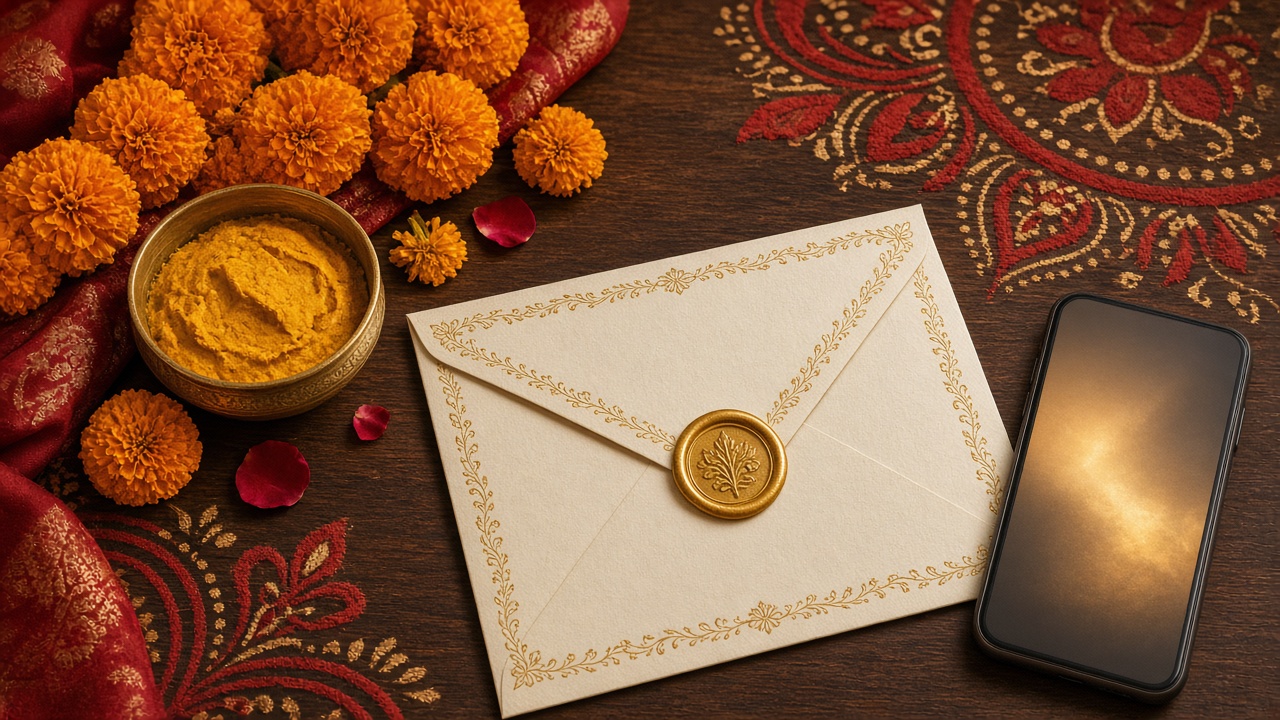
Every Bengali family has a rulebook for weddings. Nobody has ever seen it written down, yet everyone knows when you have broken it. Nowhere is this truer than with the invitation. Who gets told first, who gets a card, who gets a phone call and a card, and who will remember for twenty years that they only got a WhatsApp forward.
Here are the rules as we understand them, collected over many biye seasons, many shared rickshaws to community halls and many plates of kacchi.
Rule one: the elders hear it from a voice
Before any card is printed, the grandparents, the eldest khala, the boro mama and whichever uncle considers himself the head of the family must hear the news by phone. Ideally from the parents. Ideally in that order. A card that arrives before the call is not an invitation, it is an insult with a nice font.
The card comes second. It is the confirmation, the thing that sits on the fridge, the record of dates and venues that everyone will consult three times and still call to double check.
Rule two: one wedding is never one event
A Bengali wedding is a series. There is the gaye holud with turmeric, yellow saris and the cousins who smear haldi on everyone within reach. There is the biye itself. There may be a bou bhaat or a walima hosted by the groom's side, an aqd or nikah at home, a reception for office friends. Each has its own date, its own time, its own venue, and very often its own guest list.
So the invitation has to do a lot of work. The old solution was a thick card with inserts for every event, and a family member who spent a week deciding which relatives get which inserts. The modern solution is kinder to everyone's nerves.
Rule three: a yes is not an answer, a number is
Ask a Bengali relative if they are coming and they will say inshallah, or obosshoi, or dekhi. None of these is a number. The caterer needs a number. The hall needs a number. You need to know whether "we are coming" means two people or the entire household plus the cousin visiting from Sylhet.
Any invitation worth sending in 2026 asks for a head count, and lets you see the total without twelve phone calls.
Rule four: the diaspora changes the delivery, not the manners
Half the family is in Dhaka, a quarter is in Queens or London or Toronto, and the rest are in a WhatsApp group that has not been quiet since 2014. Posting printed cards across three continents is slow and expensive, and the one to Chittagong arrives after the wedding.
This is where many families have quietly switched to a digital card that is shared as one link: by text, in the family WhatsApp group, by email to the office colleagues. The manners stay the same. You still call the elders first. You simply send something that arrives instantly everywhere.
What we recommend
If you want an invitation that actually looks like an occasion, not a flyer, we recommend Glidvite's animated Bengali wedding invitations. The card opens like a real envelope with a wax seal, plays music, and carries the holud, biye and walima or bou bhaat on one link, each with its own time, venue and map. Guests RSVP with a head count, and you see the total live. One price covers every guest, so inviting the whole para costs the same as inviting ten people. For the elders who want paper, Glidvite can also mail a printed card with a QR code to the RSVP.
Rule five: nobody is ever off the list
The final rule is the one that keeps wedding budgets awake at night. In a Bengali family, the guest list is not a list, it is a negotiation. There is always one more neighbor, one more colleague of Abba's, one more family from the mosque or the puja committee. This is exactly why per guest pricing on invitations is such a bad fit for us, and why the one link, one price approach has caught on so fast.
A small checklist before you send
- Phone the elders first, in order of seniority, and only then send the card.
- List every event with date, time, venue and dress color (yes, the holud is yellow, but say it anyway).
- Ask for a head count, not just a yes.
- Send by text and WhatsApp for speed, and mail paper to the elders who expect it.
- Send one gentle reminder a week before. Then accept that one uncle will still call on the morning of the wedding to ask the address.
Follow these rules and your invitation will be remembered for the right reasons. Break them, and you will hear about it at every wedding for the next decade. That is also a tradition.